Acrylic vs Polyurethane Waterproofing: What You Should Know?

Acrylic waterproofing and polyurethane waterproofing are two of the most commonly used waterproofing membranes, which are used to protect buildings from water and moisture penetration. In order to choose the right type of waterproofing membrane, you should know the differences between them before you apply.
As waterproofing experts, Aqviz, we prepared a complete comparison guide by considering the acrylic vs polyurethane waterproofing. We have included the main differences in material composition, water resistance, breathability, flexibility, chemical resistance, and UV resistance. As minor differences, we included adhesion, tear resistance, seam integrity, root penetration resistance, eco-friendliness, fire resistance, anti-slip resistance, toxicity, and self-expanding capability.
These are the material composition, performance, durability, and environmental resistance comparisons between acrylic and polyurethane Waterproofing.
- Acrylic waterproofing is applied as a liquid coating, while polyurethane waterproofing is applied as a liquid membrane with controlled thickness and curing.
- Acrylic waterproofing costs about $10–$18 per 1 m², while polyurethane waterproofing costs about $10–$25 per 1 m².
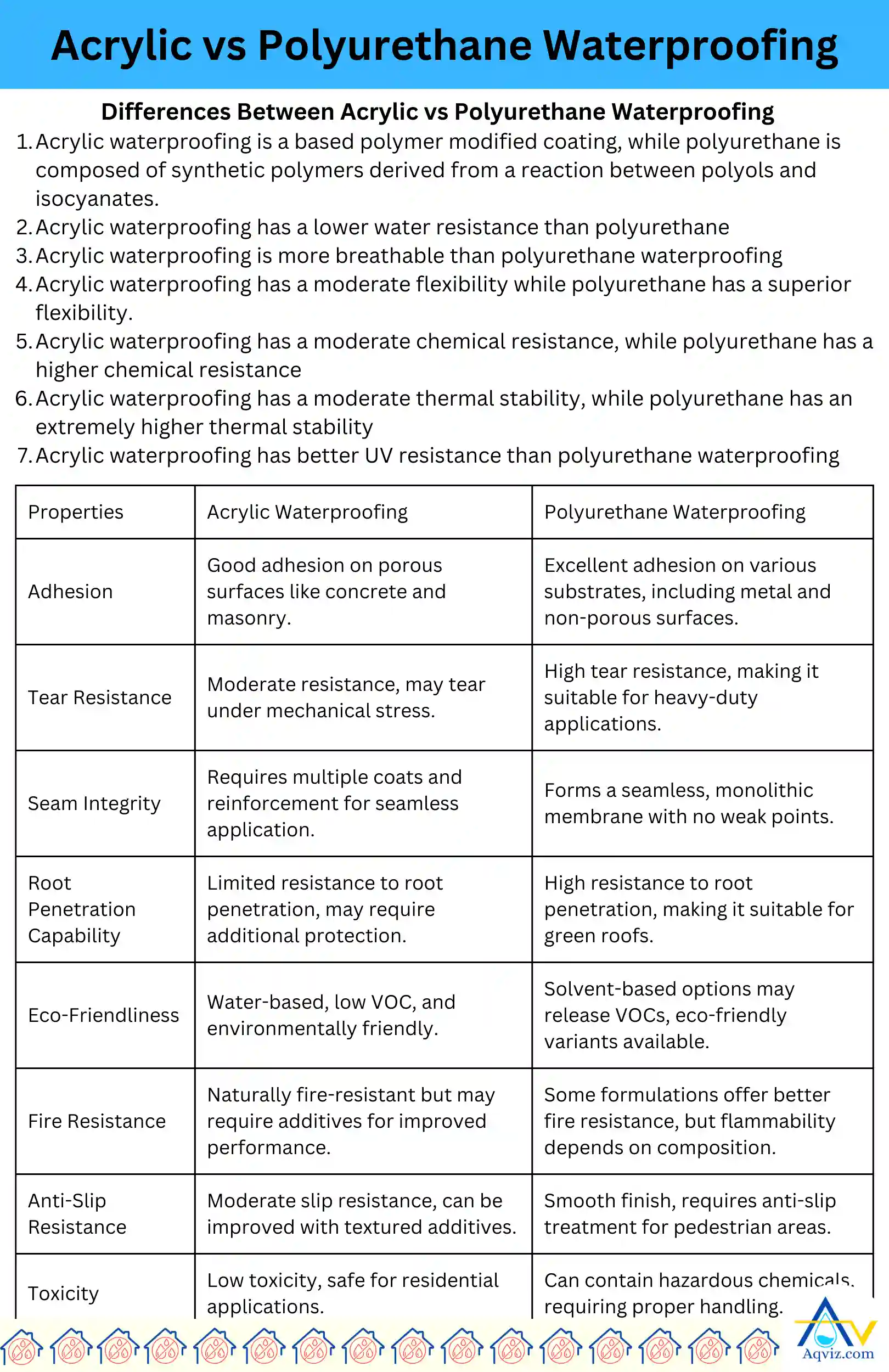
- Acrylic waterproofing is a water-based polymer-modified coating, while polyurethane is composed of synthetic polymers derived from a reaction between polyols and isocyanates.
- Acrylic waterproofing has a lower water resistance than polyurethane waterproofing
- Acrylic waterproofing is more breathable than polyurethane waterproofing
- Acrylic waterproofing has a moderate flexibility, while polyurethane has a superior flexibility.
- Acrylic waterproofing has a moderate chemical resistance, while polyurethane has a higher chemical resistance
- Acrylic waterproofing has a moderate thermal stability, while polyurethane has an extremely high thermal stability
- Acrylic waterproofing has better UV resistance than polyurethane waterproofing
Application Differences Between Acrylic and Polyurethane Waterproofing
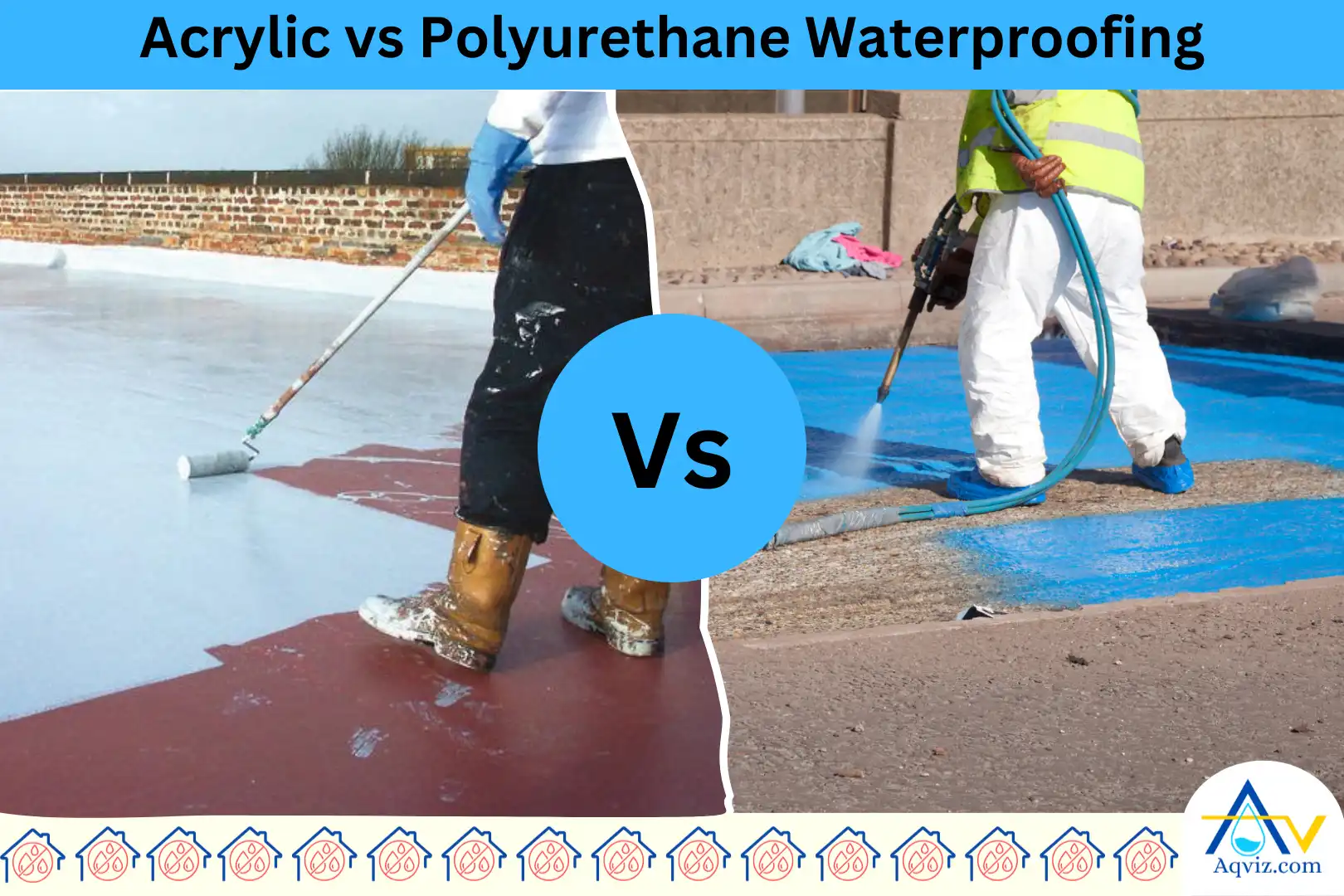
Acrylic waterproofing is applied as a liquid coating, while polyurethane waterproofing is applied as a liquid membrane with controlled thickness and curing.
Acrylic waterproofing is applied as a liquid coating using a brush, roller, or spray machine. When acrylic waterproofing is mixed and applied, it forms a seamless, water-based membrane after drying. Acrylic waterproofing is typically applied in 2-3 coats with a total dry film thickness of 1.0-2.0 mm (0.04-0.08 in). Acrylic waterproofing requires a dry surface and ambient temperatures above 10°C (50°F) for proper curing, making it suitable for terraces, balconies, external walls, and sun-exposed areas.
Polyurethane waterproofing is applied as a liquid-applied elastomeric membrane using a roller, squeegee, or airless spray. When polyurethane waterproofing is applied, it reacts chemically to form a highly elastic and fully bonded membrane. Polyurethane waterproofing is usually applied in 1-2 coats with a controlled thickness of 1.5-2.5 mm (0.06-0.10 in). Polyurethane waterproofing requires strict surface preparation, moisture control, and primer application, making it suitable for roofs, podium slabs, basements, and high-movement structures.
Cost Differences Between Acrylic and Polyurethane Waterproofing
Acrylic waterproofing costs about $10–$18 per 1 m², while polyurethane waterproofing costs about $10–$25 per 1 m².
Acrylic waterproofing typically falls in the $1-$4 per square foot range (≈ $10-$18 per 1 m²) for liquid-applied acrylic membranes, depending on product quality, number of coats, and surface preparation. These prices reflect material cost; professional labor can increase the total to the upper range.
Polyurethane waterproofing costs more because it offers higher elasticity and chemical resistance. Liquid polyurethane membranes generally range from $1.5-$8 per square foot (≈ $16-$86 per 1 m²) for material only, with typical commercial jobs averaging around $10-$25 per 1 m² once labor and primers are included
Composition Differences between Acrylic and Polyurethane Waterproofing
Acrylic waterproofing is a water-based polymer-modified coating , while polyurethane is composed of synthetic polymers derived from a reaction between polyols and isocyanates .
Acrylic waterproofing is a water-based, polymer-modified coating that is made from acrylic resins. Acrylic waterproofing consists of compounds such as acrylic polymer, water, fillers, pigments, additives, and preservatives. Acrylic forms a highly water-resistant, UV-resistant, flexible protection layer on the substrate after it is applied. This is an environmentally friendly coating with low VOC.
Polyurethane waterproofing is composed of synthetic polymers derived from a reaction between polyols and isocyanates. It forms a seamless, super-elongated elastomeric membrane when it is applied to the substrate.
Water Resistance Differences between Acrylic and Polyurethane Waterproofing
Acrylic waterproofing has a lower water resistance than polyurethane waterproofing
Acrylic waterproofing has a moderate water resistance. Acrylic waterproofing membrane creates a protective barrier on the substrates that repels moisture but remains slightly permeable. The water resistance of this membrane depends on the number of coats applied and environmental conditions. Due to the moderate water resistance of the acrylic waterproofing membranes, it is highly recommended for the light to moderate water exposure areas.
Polyurethane waterproofing provides superior water resistance over time without any cracks or damage due to its elastic nature. It can withstand various weather conditions and even small structural movements.
These are the most commonly used 10 types of waterproofing membranes, which are used for building waterproofing. You should read all of the 10 Types of Waterproofing Membranes before you start your waterproofing project.
Breathability Differences between Acrylic and Polyurethane Waterproofing
Acrylic waterproofing is more breathable than polyurethane waterproofing
Acrylic waterproofing is highly breathable. Acrylic waterproofing allows trapped moisture to escape the trapped moisture from the substrate. Higher breathability of the acrylic waterproofing reduces the risk of blistering and peeling the waterproofing membrane and making it suitable for areas prone to dampness.
Polyurethane waterproofing is less breathable than acrylic waterproofing due to its dense molecular structure. Polyurethane waterproofing forms an airtight seal that locks out moisture completely, which is beneficial for areas requiring total water exclusion. However, poor ventilation beneath the membrane can lead to trapped moisture issues, such as mold and mildew growth and blistering. To prevent these problems, the substrate should be prepared properly
Flexibility Differences between Acrylic and Polyurethane Waterproofing
Acrylic waterproofing has a moderate flexibility, while polyurethane has a superior flexibility.
Acrylic waterproofing provides moderate flexibility. It helps to accommodate minor surface movements without cracking the waterproofing layer. Acrylic waterproofing’s elasticity depends on the thickness and reinforcement used for the mixture. Hence, acrylic waterproofing has a limited stretch range and should not be used in high-movement areas.
Polyurethane waterproofing offers superior flexibility due to its elastomeric nature. It can stretch and recover without losing its adhesion. Hence, polyurethane waterproofing is ideal for surfaces that is subjected to expansion and contraction over time. The high flexibility of the PU prevents cracks and failures in dynamic structures.
Chemical Resistance Difference between Acrylic and Polyurethane Waterproofing
Acrylic waterproofing has a moderate chemical resistance , while polyurethane has a higher chemical resistance
Acrylic waterproofing has moderate chemical resistance. Hence, it is suitable for general outdoor and residential applications. Acrylic waterproofing can withstand mild acids, alkalis, and UV exposure, but prolonged exposure to harsh chemicals or industrial pollutants can degrade its performance over time.
While polyurethane waterproofing exhibits excellent chemical resistance, it also protects surfaces from oils, solvents, and aggressive chemicals. Its dense composition makes it suitable for industrial settings, chemical plants, and areas exposed to contaminants, ensuring long-term durability in harsh environments.
Temperature Stability Differences Between Acrylic and Polyurethane Waterproofing
Acrylic waterproofing has a moderate thermal stability, while polyurethane has an extremely high thermal stability
Acrylic waterproofing has a moderate temperature stability range, but it can soften under extreme heat or become brittle in freezing conditions. Hence, acrylic waterproofing is suitable for temperate climates but may require additional protection in areas with severe temperature fluctuations to protect the layer from extreme temperatures.
While polyurethane waterproofing has exceptional temperature stability, it maintains flexibility and adhesion across a wide range of conditions. It resists thermal expansion and contraction, making it ideal for both hot and cold climates, ensuring long-lasting performance without cracking or degradation.
UV Resistance Differences Between Acrylic and Polyurethane Waterproofing
Acrylic waterproofing has better UV resistance than polyurethane waterproofing
Acrylic waterproofing has excellent UV resistance due to its water-based acrylic resins, which naturally reflect sunlight and prevent degradation. It resists yellowing, chalking, and surface breakdown. Hence acrylic waterproofing is ideal for exposed areas like terraces, roofs, and facades. Its UV stability helps maintain its durability and appearance over time.
While polyurethane waterproofing has lower UV resistance than acrylic waterproofing membrane. When the PU is exposed to sunlight, it can yellow, harden, or degrade due to UV light. As well as PU coating can be cracked or lose flexibility when it is exposed to UV light for a prolonged. In order to prevent this, PU is formulated with UV stabilizers.
Read our similar expert guide related to acrylic and polyurethane waterproofing
- Acrylic vs Epoxy waterproofing
- Cementitious vs Polyurethane waterproofing
- Bituminous vs Polyurethane waterproofing
Functional and Environmental Comparisons Between Acrylic and Polyurethane Waterproofing
These are the mechanical strength, safety, environmental impact, and usability comparisons between acrylic and polyurethane Waterproofing
| Properties | Acrylic Waterproofing | Polyurethane Waterproofing |
| Adhesion | Good adhesion on porous surfaces like concrete and masonry. | Excellent adhesion on various substrates, including metal and non-porous surfaces. |
| Tear Resistance | Solvent-based options may release VOCs, eco-friendly variants are available. | High tear resistance, making it suitable for heavy-duty applications. |
| Seam Integrity | Requires multiple coats and reinforcement for seamless application. | Forms a seamless, monolithic membrane with no weak points. |
| Root Penetration Capability | Solvent-based options may release VOCs, eco-friendly variants aare vailable. | High resistance to root penetration, making it suitable for green roofs. |
| Eco-Friendliness | Water-based, low VOC, and environmentally friendly. | Moderate resistance may tear under mechanical stress. |
| Fire Resistance | Naturally fire-resistant but may require additives for improved performance. | Some formulations offer better fire resistance, but flammability depends on composition. |
| Anti-Slip Resistance | Moderate slip resistance, can be improved with textured additives. | Smooth finish, requires anti-slip treatment for pedestrian areas. |
| Toxicity | Low toxicity, safe for residential applications. | Can contain hazardous chemicals, requiring proper handling. |
| Self-Expanding Capability | No self-expanding properties. | Some formulations have self-leveling and expanding characteristics. |
What is Polyurethane Waterproofing in Construction?
The polyurethane waterproofing in construction is applying an elastomeric waterproofing system on the substrate to stop water penetration to the surface.
Polyurethane waterproofing is widely used to stop water leaking in construction because it has an adhesion strength of 1.5 N/mm² (217 psi), elastic elongation of 300%, water absorption of 1%, and hydrostatic pressure resistance of 1.5 bar (21.7 psi), which together allow the membrane to bond strongly, bridge cracks, and resist continuous water exposure.
PU waterproofing can be applied on the surface using a roller, brush, or airless spray. The PU thickness should be 1.5-2.0 mm (60-80 mils), and it remains stable between –40 °C to +80 °C (–40 °F to 176 °F). It can withstand 10-25 years, and its cost ranges from USD 4-8 per sq ft (USD 43-86 per m²).
Is Polyurethane Water Resistant?
Yes, polyurethane is water-resistant because of its closed-cell chemical structure, low water absorption below 1.0% by weight, high adhesion strength above 1.5 N/mm² (217 psi), and elastic elongation exceeding 300%, which together block capillary water movement, tolerate thermal expansion, and prevent cracking under service loads.
Therefore, polyurethane waterproofing can be used on areas exposed to intermittent or continuous moisture such as flat roofs and terraces with ponding water up to 48-72 hours, balconies and podium slabs exposed to rainfall and UV radiation, bathrooms and wet areas under ceramic or stone tiles, basements and retaining walls resisting groundwater pressure up to 1.5 bar (21.7 psi), and movement-prone zones including parapets and expansion joints where crack width remains ≤2.0 mm (0.08 in), based on our field experience at Aqviz.
Is Polyurethane Waterproof?
Yes, polyurethane is waterproof because it consists of polyol and isocyanate compounds, which chemically react to form a cross-linked polyurethane polymer network with a dense and closed molecular structure.
When it is applied on the substrate, it forms a water-impervious elastomeric layer on the surface by curing into a seamless, joint-free membrane that blocks capillary pores, seals microcracks, and resists water diffusion through the film. This cross-linked structure provides low water absorption around 1%, strong chemical bonding to the substrate, and elastic behavior that maintains waterproof integrity even under thermal movement and continuous water exposure.
Is Polyurethane Acrylic?
No, polyurethane is not acrylic. Polyurethane and acrylic are two different polymer systems with different chemical compositions, performance characteristics, and construction uses.
Polyurethane is synthesized from polyols and isocyanates, forming a cross-linked elastomeric polymer with high elasticity, strong adhesion, and excellent resistance to standing water. Acrylic coatings are produced from acrylic ester polymers dispersed in water, resulting in a more breathable, UV-stable, and cost-effective coating designed mainly for surface protection.
What is Acrylic Waterproofing?
The acrylic waterproofing membrane is a water-impervious layer that is installed on the building surface to prevent water from leaking inside the structure. Acrylic waterproofing consists of 6 compounds: acrylic polymer, water, fillers, pigments, additives, and preservations. Acrylic waterproofing membranes are mainly 3 types: liquid, sheet, and cementitious.